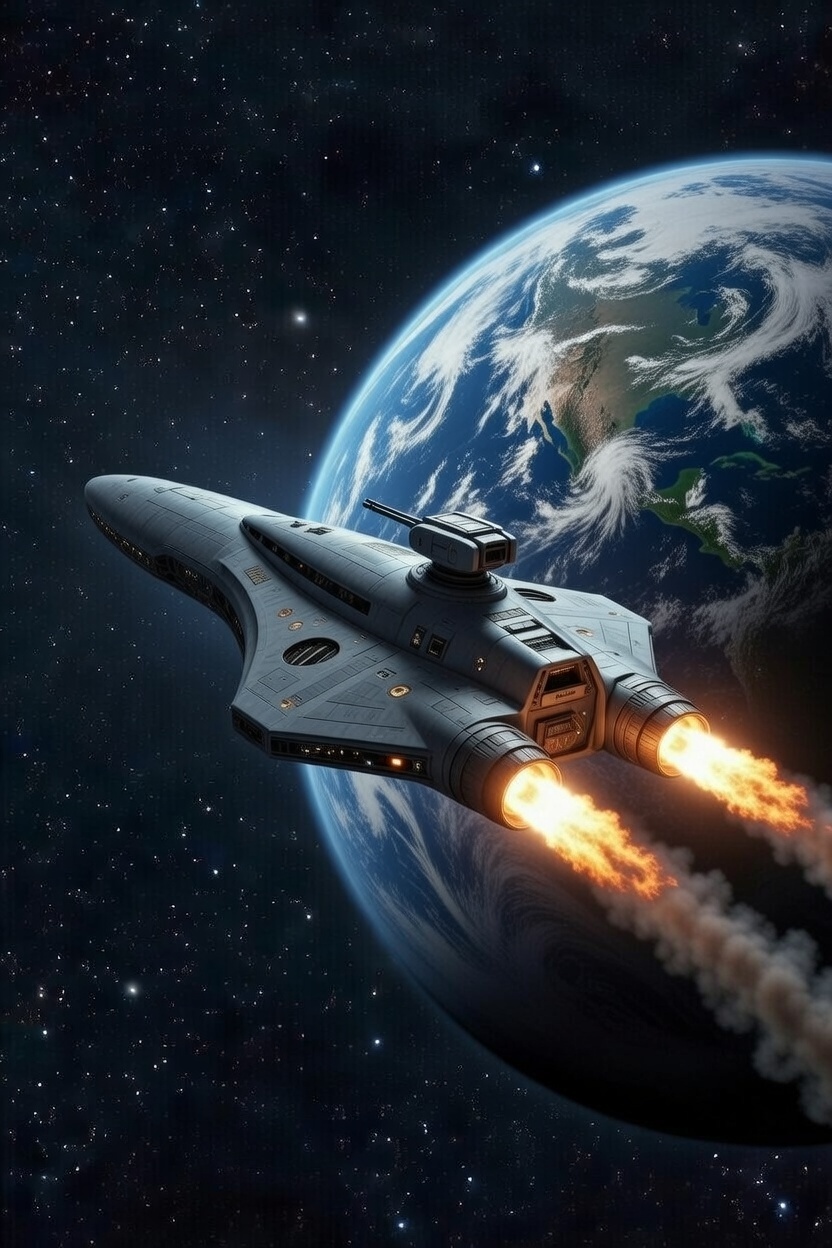

Odyssey’s Journey – Chapter 1 – Earth Orbit
The conference module aboard the *Verya* had settled into a comfortable hush, the golden light softening as Earth’s terminator line crept across the viewport below. Coffee cups were empty, nutrient pods mostly untouched, and the weight of the bigger question hung in the air like humidity before a storm.
Odyssey’s Journey – Chapter 1 – Earth Orbit
Thren Toranki straightened, his amber eyes steady. “We have debated guests versus immigrants long enough. There is not time for the standard bureaucratic ballet—visas, hearings, background checks that would take years while the Vorrak continue their expansion unchecked. If they arrive in force, paperwork will be the least of our concerns.”
Elena nodded slowly. “You’re right. The window is closing.”
Thren continued, voice calm but resolute. “The fastest path is direct. I request an immediate audience with your President. Face to face. No intermediaries, no endless committees. We lay out the situation plainly: our situation, the Vorrak threat, the need for cooperation. From there, we negotiate terms that allow my crew to descend safely and contribute meaningfully.”
Sophia’s grin flashed—sharp, eager. “And while you’re in the Oval Office charming the socks off the Secret Service, we hit them with the real ask: authorization to stand up a Space Defense Force. Right now. Not in five years, not after another budget cycle. Led by you, Captain Thren Toranki, because no one else on this rock knows how to spot, track, and politely discourage a Vorrak incursion. We start small—patrol wings, sensor nets, a tripwire constellation in the outer system. Give the Vorrak something to think about before they even light their drives for Sol.”
Elena raised an eyebrow. “You want to pitch an interstellar navy to the President on day one?”
Sophia shrugged. “Why not? We’ve already given them free cancer cures and infinite electricity. Might as well go big. Besides, the public’s already calling him ‘Space Dad.’ Lean into it.”
Thren’s mouth curved in that subtle Kaelith almost-smile. “I will insist that my crew be permitted to come planetside. The *Verya* requires extensive repairs—dry-dock time, heavy fabrication, stress testing on components we cannot fully replicate in orbit. We cannot remain indefinitely in this orbit without risking structural fatigue. My people need gravity, fresh air, and access to industrial facilities. A secure location would be ideal.”
Sophia jumped in before Elena could respond. “Uninhabited Hawaiian island. You already floated it. Make it part of the package. Low-profile landing zone, restricted airspace, environmental oversight so the activists don’t riot. Call it a joint research and repair outpost. The Navy gets to play host, the environmentalists get to monitor, and your crew gets a beach without turning Waikiki into a mosh pit.”
Elena exhaled through her nose, half amusement, half resignation. “You two are going to give the White House staff heart attacks. But… it’s not a bad play. Direct presidential access bypasses layers of red tape. If the President buys in, the rest of the government falls in line—or at least pretends to. And Hawaii? Politically symbolic, geographically isolated, already has the infrastructure for secure ops. The optics could work: ‘Aliens Choose Aloha, Pledge to Defend Earth.’ The memes write themselves.”
Thren inclined his head. “Then it is settled. I will prepare a formal request for an audience. You will transmit it through secure channels. We ask for the meeting within the next seventy-two hours—time is not our ally.”
Sophia stood, already buzzing. “I’ll draft the talking points. Short, punchy. ‘Hi, Mr. President. We brought you free energy and medicine. In return, we’d like a navy, a tropical repair base, and permission to be humanity’s first line of defense against space jerks. Mahalo.’”
Elena shot her a look. “Maybe soften the ‘space jerks’ part.”
“Fine. ‘Uninvited stellar neighbors.’ Better?”
Thren allowed himself a quiet chuckle—the sound surprisingly warm and human-like. “I will trust your cultural nuance. But emphasize the urgency. The Vorrak do not negotiate from a position of patience.”
Elena pulled out her comm tablet. “I’ll send the request up the chain now. Marked Priority Alpha, eyes-only to the National Security Advisor first. If they green-light it, we’ll have a sit-down in days—probably at a secure site stateside, then shuttle you down. No fanfare, no press until after.”
Sophia cracked her knuckles. “And when the President says yes—and he will, because who turns down free alien tech support?—we start sketching patrol routes. I want first dibs on a destroyer command. Something fast. Something that goes zoom.”
Thren regarded her with fond exasperation. “One step at a time, Sophia Chin. First we meet the leader of your world. Then we discuss zoom.”
Elena tapped send. The message vanished into encrypted channels, racing toward Washington.
Outside the viewport, Earth continued its slow turn—peaceful, unaware, and about to get the strangest diplomatic house call in history: twelve very human-like explorers requesting a presidential audience, a space navy, and a quiet corner of Hawaii to fix their ship and maybe save the planet.
Somewhere in the Oval Office, a staffer’s phone was about to buzz with the most surreal email of their career.
And Thren Toranki, lifelong pacifist and accidental galactic celebrity, simply folded his arms and waited.
The galaxy had a way of accelerating plans.
Especially when it smelled like plumeria and plasma cannons.
Odyssey’s Journey – Chapter 2 – Space Force
The Oval Office smelled faintly of polished wood, fresh coffee, and the nervous sweat of aides who had spent the last forty-eight hours rewriting briefing books titled things like “First Contact Protocols: Alien Edition” and “How Not to Piss Off the Guy Who Gave Us Free Energy.”
President Elena Vasquez sat behind the Resolute Desk, sleeves rolled up, tie loosened, looking exactly like someone who had been awake for thirty-six hours straight but was still trying to project calm authority. Flanking her were the National Security Advisor (arms crossed, eyebrows permanently raised), the Secretary of Defense (quietly calculating how many carrier groups would be needed if this went sideways), and a single Secret Service agent who kept glancing at the door like he expected Thren to burst in with tentacles.
The door opened.
Captain Thren Toranki entered first—tall, bronze-skinned, amber-eyed, moving with the easy grace of someone who had spent years on exploratory vessels rather than parade grounds. Behind him came Elena Reyes and Sophia Chin. Sophia was in civilian clothes but wearing the kind of grin that said she was mentally already commanding a destroyer. Elena looked professional, if mildly amused at the sheer absurdity of the moment.
Thren stopped three paces inside, inclined his head in a gesture that managed to be both respectful and regal.
“Madame President,” he said, voice calm and modulated through the subtle implant that made his English sound almost too perfect. “Thank you for receiving us on such short notice.”
Vasquez stood, came around the desk, and extended her hand without hesitation. “Captain Toranki. The pleasure—and the surrealism—is mine. Please, sit.”
They settled into the facing sofas. Thren took the center, Elena Reyes and Sophia on either side like wingmen. The President’s team stayed standing for a beat longer than necessary, as if waiting for the other shoe to drop.
Vasquez broke the ice first. “I’ve read the briefings. Clean energy grids online in thirty-seven countries. Cancer remission rates up eighty percent in trial cohorts. And now you’re here to ask for… what, exactly?”
Thren met her eyes directly. “Time is short, Madame President. The Vorrak—the species that damaged my ship and forced our arrival here—are expansionist. They do not negotiate from weakness. They will eventually probe this system. When they do, Earth must be ready to respond—not with aggression, but with credible deterrence.”
The NSA Advisor cleared his throat. “You’re proposing we build a space navy. Overnight.”
“Not overnight,” Thren corrected gently. “Immediately. A Space Defense Force—small at first. Patrol wings, sensor constellations, early-warning tripwires in the outer system. I offer myself to lead it, at least in the formative stages. My crew and I have direct experience with Vorrak tactics. No one else on this world does.”
The SecDef leaned forward. “And your ship? The *Verya* needs repairs. Dry-dock time. Fabrication access.”
Thren nodded. “Precisely. My crew of twelve cannot remain indefinitely in orbit. Structural fatigue will set in. We require a secure location planetside—industrial facilities, gravity, fresh air. I propose an uninhabited island in the Hawaiian chain. Restricted airspace, environmental oversight, low visibility. We would treat it as a joint research and repair outpost. No weapons testing. No permanent structures beyond what is necessary for maintenance.”
Sophia couldn’t help herself. “Think of it as diplomatic camping with really good Wi-Fi. Your Navy gets bragging rights, the environmentalists get to watch us like hawks, and we get to fix our ride without turning Honolulu into Comic-Con for aliens.”
Vasquez’s lips twitched—almost a smile. “You’ve clearly thought this through.”
Thren leaned forward slightly. “Madame President, I am a pacifist by conviction. I chose an exploratory vessel to avoid conflict, not seek it. But I cannot stand idle while a threat approaches a world that has welcomed us. Grant us the authority to stand sentinel. Let us help build the defenses that will keep the peace. In return, we offer our knowledge, our technology, and our commitment to never initiate force.”
Silence stretched for five full seconds.
The President glanced at her advisors. The NSA guy looked like he’d swallowed a lemon. The SecDef was already mentally redrawing budget lines. Vasquez exhaled slowly.
“Captain Toranki… Thren. You gave us the keys to end resource wars and cure diseases before we even asked. That buys you a hell of a lot of goodwill.” She paused. “I’m authorizing the formation of the United States Space Defense Force—provisional, for now. You’ll command it as Senior Advisor and acting commander until Congress can catch up. We’ll fast-track legislation. Hawaii… we’ll designate one of the smaller, uninhabited islands—probably Ni’ihau waters or a section of Kaho’olawe—as a secure joint facility. Restricted zone, joint oversight. Your crew lands tomorrow under Marine escort. No press. No fanfare. Yet.”
Sophia’s grin threatened to split her face. “Mahalo, Madam President.”
Vasquez turned to Thren. “One condition: no surprises. Full transparency on Vorrak movements. And if this turns hot… we fight together. No lone-wolf stuff.”
Thren inclined his head again. “Agreed. Together.”
Vasquez stood. “Then it’s done. Welcome to the team, Captain. And welcome to Earth—properly this time.”
As handshakes were exchanged and aides began whispering furiously into earpieces, Sophia leaned toward Thren and muttered under her breath:
“Told you. Space Dad gets the keys to the kingdom. Now let’s go pick out our island before the tourists start booking ‘Alien Airbnb’ listings.”
Thren allowed himself the smallest, most human-like chuckle. “One step at a time, Commander Chin.”
Outside the windows, Washington D.C. carried on—oblivious for now.
But high above, in geostationary orbit, the *Verya* waited—repaired, powered, and soon to have company planetside.
The galaxy had just gotten a little more crowded.
And a lot more defended.
Odyssey’s Journey – Chapter 3 – The Vorrak
The void was never truly empty, not in the coreward fringes where the stars thinned and the dark between them grew thick with possibility—and threat.
Aboard the Vorrak heavy cruiser Krag'thul, Captain Vorath-Kai stood on the command deck, his broad, armored frame casting a long shadow under the harsh crimson lighting. The Vorrak were built for war: squat, heavily muscled bipeds with thick gray-green hide scarred from ritual combat and plasma burns, four-fingered hands ending in blunt claws, and eyes like polished obsidian set deep in ridged skulls. Their ships reflected that—brutish, angular, plated in ablative ceramic and bristling with railguns and kinetic lances. No elegance, only function. Efficiency was for the weak.
The tactical holotank flickered as the sensor ghost resolved into certainty: a single ship, sleek and elongated, accelerating hard toward the hyperspace threshold. Unknown design. Not Vorrak. Not one of the fractured Accord remnants they usually hunted. No weapons signature, no heavy armor plating. Just speed, and now—impossibly—acceleration that mocked their own engines.
Finally, they located the ghost ship they had been seeking for the last 6 time frames. All attempts to locate the ghost ship had proved fruitless until one of the ground parties stumbled on it, and stumbled was the word since the ground party was not looking for it, but was looking for loot in the bombed-out city of Ruka-Kng. Luckily for them, they found it because their absence had been noted and they were marked for discipline,
“Power curve spiking,” the sensor officer growled, his voice gravelly through his respirator mask. “Drive signature unknown. Not military. Too clean, too fast. Spy vessel? Exploration scout? It entered our space months ago and landed somewhere on Ruka-Kng. We scorched it years back after the population rose up in revolt. We assumed it was probing for weakness or mapping our borders. We were wrong. It’s fleeing.”
Vorath-Kai’s mandibles clicked in irritation. “Target the drive spines. Disable, do not destroy. We want the cores intact—whoever they are, and what they intend may be vital.”
The Krag'thul rolled ponderously, aligning its forward batteries. A salvo of kinetic slugs—dense slugs filled space. Too late:
“They’re jumping,” the weapons officer snarled. “They’ll make the fold.”
Vorath-Kai stared at the holotank, claws flexing. Whatever that ship was—spy, explorer, scavenger—it had come from the dead world they had bombed to ash, lingered in secret, and now fled outward with power no Kaelith scout should possess. Something had changed it. Something valuable.
“Last heading noted,” he said. “Extrapolate vector. Full sensor sweep on residual wake.”
The nav officer complied. Lines of probability spidered out across the display. Coreward vectors dominated at first, but the cleanest path bent outward—toward the galactic rim.
“Outward,” the officer reported. “Sparse region. Few K-type suns. Habitable zones narrow. Low probability of an advanced world.”
Vorath-Kai’s eyes narrowed. K-type stars—orange, long-lived, stable—were rare out there. It appears they were headed for one of the few systems capable of sustaining life.
“Transmit to High Command,” he ordered. “Priority alpha. The intruder escaped.”
The Krag'thul slowed, turning to begin the long, inefficient spiral back toward a resupply depot. The Vorrak hyperdrives would kill another generation of crew before they could follow—but follow they would.
Eight periods later, deep in the fortified orbital yards above the Vorrak homeworld, High Command gathered in the iron-domed war chamber. The chamber reeked of ozone and hot metal; holographic star maps drifted slowly overhead, with red threat vectors pulsing like wounds.
High Marshall Grath-Vor listened to Captain Vorath-Kai’s after-action report silently. When the captain finished, Grath-Vor spoke in the low, rumbling tone reserved for final orders.
“The intruder entered our space undetected, lingered on a world we had already cleansed, and departed with performance beyond any known scout vessel. It is not a coincidence. It found something—technology, resources, an ally. Without knowing who they are or what their intentions are, we must pursue.”
He turned to the chief engineer, a scarred veteran whose left arm had been replaced by a crude prosthetic claw.
“Build two autonomous hunter-killers. Strip every unnecessary system. Mount the most powerful engines we can forge—overclocked, short-life cores. Equip them with our latest AI ayatwm. Give them sensor suites to track residual wakes across decades if necessary. Arm them with our most powerful weapon and program it for kill on sight.”
The engineer nodded. “And recording?”
“Full archival redundancy,” Grath-Vor said. “Each probe will carry dual black-box cores—armored, radiation-hardened, with quantum-encrypted burst transmitters. Every scan, every visual capture, every intercepted emission, every anomaly detected will be logged in real time. If they find the intruder, if they reach its destination, if they encounter new threats or prizes—we must know.”
The engineer’s prosthetic claw clicked in acknowledgment. “It will take three cycles to construct. The engines will burn out after two jumps—maybe three. But they will reach the edge. And whatever they find there… the records will return, one way or another.”
Grath-Vor’s obsidian eyes gleamed. “Then let them burn. The Empire does not forgive trespass. And it does not forget. That better not fail.
One more thing. Notify our researchers. Give them this mandate: Improve our hyperdrives, or they and all living relatives and friends will be retired to the infinite void. Tell them they will have access to any and all resources needed to accomplish the task. Failure is not an option.”
Somewhere in that darkness, the unknown ship had vanished.
High Command had just unleashed the hounds—two cold, relentless machines, each carrying the unblinking eye of the Vorrak Empire in their armored data hearts.
And the hunt—mechanical, patient, unfeeling —had begun.
Odyssey’s Journey – Chapter 4 – Trip Wire
The secure conference link stayed open long after the politicians had been politely excused. Only the people who actually flew the ships remained: Elena and her crew on Odyssey, Thren and his senior staff on Veyra. The blue curve of Earth filled the background like a silent judge.
Thren leaned forward, the violet lighting of Veyra’s bridge making his slate-gray skin look almost luminous.
“There is one more thing your world must understand about hyperspace transitions,” he said. “No ship—ours, yours once you have the technology, or the Vorrak—can drop out of the manifold inside a significant gravity well. The Sun’s field is more than strong enough. Any vessel attempting it would be torn apart by tidal shear. Therefore, every arrival must occur in the outer fringes of the system—beyond the Kuiper Belt, often out past 80 to 120 AU.”
Sofia’s eyebrows rose. “That’s… a long way out.”
“Exactly,” Thren continued. “And that distance is your friend. Even the fastest ships we know of—ours included—cannot simply sprint to Earth in a few days. Acceleration has limits. Structural stress, fuel, crew tolerance. Let me show you.”
He transmitted a simple plot. The numbers appeared on every screen.
Assumed dropout radius: 100 AU Distance to Earth: ≈ 99 AU ≈ 9.2 billion miles
At 100,000 mph (roughly 2.5× Voyager speed): 3,835 days — over ten years. At 500,000 mph (aggressive interplanetary cruise, pushing hull limits): 767 days — more than two years. At 1,000,000 mph (the absolute upper bound for sustained flight with current materials): 383 days — still over a year.
Thren let the figures hang in the air.
“Even if a hostile force pushed their engines to destruction trying to reach you faster, the soonest any ship could arrive after detection would be measured in weeks, not days. The Vorrak, with their crude drives, would take months. Possibly longer. Your sensor drones do not need to give you minutes of warning. They can give you weeks. Months, if the enemy is cautious.”
Marcus whistled low. “So the early-warning net isn’t just a tripwire. It’s a calendar.”
“Precisely,” Thren said. “Build the drones. Seed them outward in concentric shells—first at 50 AU, then 80, then 120. Equip them with the subspace resonators I described. When one pings a transition, the entire network will triangulate the dropout point within hours. You will know the vector, the signature, the probable identity. And then you will have the time to decide: meet them, hide from them, or prepare to fight them.”
Elena stared at the plot, the long, lazy curve of time stretching across the screen.
Sophia, also looking at the screen, commented, “ Space is really huge. How can we effectively cover that much space.”
Thren answered. “The approach is linear, not spherical. Their inefficient hyperdrives force them to emerge along the a narrow transit that is aligned with the galactic coreward direction, declination about –12°, right ascension 18h 40m.
We’re treating that as a single ‘threat axis.’ The Automated Early Warning Units (AEWU) will string out along that line like tripwires: two at 50–60 AU to catch the first wake distortion, two more at 90–110 AU for confirmation, and the last pair pushed to 140–160 AU as the outer picket. They loiter in high-eccentricity orbits that keep them tangent to the predicted emergence zone, cycling passive sensor sweeps every few hours. One solid contact and the whole chain lights up.”
Sophia just looked at Tren and shook her head. “I guess that answers that.”.
“We’ll make it happen,” she said quietly. “The drones. The network. With the planet Earth depending on us, it’ will be our number one priority.”
Thren’s black eyes met hers across the light-minutes.
“Good,” he said. “Because the Vorrak are coming. Not soon. But they are coming. And when they finally drop out of the dark at the edge of your system, they will find that Earth is no longer alone… and no longer blind.”
The link held for a moment longer, two small crews in the quiet between worlds, already building the wall that might one day keep the monsters out.
Below them, Earth turned, unaware for now - but the watch had begun.
Odyssey’s Journey – Chapter 5– The Scout Fleet
Earth's fledgling Space Defense Force had achieved its first tangible milestone: the *Ares Vanguard*, a sleek, two-man experimental scout ship that represented humanity's cautious first step toward defending the solar system.
The vessel was compact yet imposing—45 meters long, its hull a matte charcoal-gray composite designed to scatter radar and absorb lidar pings. Inside the narrow cockpit sat two acceleration couches side by side, surrounded by holographic displays, redundant manual controls, and the faint hum of life-support recyclers. The ship carried no luxuries; every cubic centimeter was dedicated to endurance, sensors, and the single experimental weapon system that defined its purpose.
Twin railguns ran along the ventral spine, each barrel a precision-engineered tube of superconducting coils capable of accelerating 5-kilogram tungsten slugs to Mach 2 in vacuum. The weapons were state-of-the-art by terrestrial standards—electromagnetic accelerators fed by massive capacitor banks that drew directly from the ship's power grid. On paper, the slugs would strike with devastating kinetic energy at interplanetary ranges. In practice, the upcoming live-fire tests would tell the real story.
Powering this entire craft was the **Stage 2 Layered Subspace Propulsion** system—the same Kaelith-derived technology that had allowed the *Verya* to reach Earth after its catastrophic jump. The drive created a nested warp envelope by sequentially "diving" into progressively shallower sub-layers of subspace, compressing effective distance without ever pushing the ship past 0.3c in its local frame. No relativistic blueshift, no extreme time dilation, no particle-frying radiation storms. The crew experienced the journey as a gentle, constant 1.5 g acceleration followed by a long coast phase inside the protective bubble. Earth to Mars at opposition: 6–9 days. Earth to the Kuiper Belt: under two weeks. The system made the outer solar system reachable in human lifetimes, turning what had once been decades-long probes into routine patrol runs.
Construction of the follow-on scout fleet—nine additional Pathfinder-class vessels—was underway in secure shipyards scattered across allied nations. All were equipped with identical Stage 2 Layered Subspace Propulsion cores, giving the entire class the same blistering interplanetary speed. But armament remained absent for now. Congressional oversight had insisted on sequential testing: propulsion first, weapons second. The nine sister ships currently sat in cradles with empty bays, sensor suites installed but railgun mounts still just structural stubs waiting for the *Ares Vanguard*'s trials to prove (or disprove) the concept.
Complementing the scouts were thirty early-warning drones in various stages of production. These small, autonomous sensor platforms—each the size of a refrigerator—were designed to be scattered across the asteroid belt and inner Kuiper fringe. Equipped with hypersensitive Kaelith-derived auspex arrays, they would form the first line of passive detection: listening for anomalous warp signatures, gravitational anomalies, or the faint drive plumes of incoming vessels. No weapons, no propulsion beyond station-keeping thrusters—just eyes in the dark, relaying data back to the Hawaiian outpost in real time.
In the final weeks before the Ares Vanguard's first live-fire exercise, Commander Sophia Chin and her Kaelith co-pilot, Lieutenant Kael Vorran (one of Thren's most experienced exploratory navigators), had been immersed in relentless training. For months they had lived inside high-fidelity simulators aboard the *Verya*—virtual cockpits that replicated every nuance of the scout's handling, from Stage 2 envelope transitions to emergency bubble collapse. They had practiced thousand-kilometer evasion maneuvers, sensor-fusion drills, and simulated railgun firings against tumbling drone targets at ever-increasing ranges. Sophia's geologist hands, once accustomed to turning over rocks, now moved across holographic controls with instinctive precision. Kael Vorran—tall, bronze-skinned, amber-eyed like Thren—brought centuries of Kaelith exploratory discipline to the partnership, his calm corrections balancing Sophia's instinctive aggression.
Now the simulators were behind them. The real ship waited in its cradle at the Kaho‘olawe Restricted Research Outpost, floodlights washing over its hull while technicians performed final umbilical checks.
Admiral Thren Toranki stood on the observation deck overlooking the bay, arms folded, amber gaze fixed on the scout. He had supervised every phase of the program: propulsion integration, structural stress tests, sensor calibration. He had authorized the Stage 2 cores without hesitation—civilian exploratory technology, after all—but the railguns were human-designed, human-built. He had not forbidden them; he had simply insisted on rigorous proof before any further escalation. Today was that proof.
Sophia and Kael Vorran emerged from the prep building in flight suits, helmets under their arms. Sophia's stride was quick, eager; Kael's measured and deliberate. They paused at the base of the boarding ramp, exchanging a single nod before climbing aboard.
Thren keyed the comm from the observation deck.
"Commander Chin, Lieutenant Vorran. Systems green across the board. Clearance for undocking in thirty minutes. Your primary objective is envelope stability and transit profile verification. Secondary: approach the designated test range at 50,000 km standoff, acquire the tumbling drone target, and prepare for simulated railgun acquisition sequences. No live fire until I give the word."
Sophia's voice came back, laced with barely contained excitement.
"Understood, Admiral. *Eclipse Thorn* is ready to dance. We'll show you what she can do."
Thren allowed himself the faintest curve of a smile.
"Show me stability first, Commander. Then we discuss teeth."
The bay doors began to iris open, revealing the star-strewn Pacific night. The Ares Vanguard—Earth's first true interstellar-capable warship, however small—lifted silently on reactionless thrusters, its Stage 2 core already whispering as it prepared to fold the void around itself.
Sophia settled into the pilot's couch. Kael Vorran strapped in beside her, hands moving across the co-pilot displays with practiced grace.
The scout rose, turned its nose toward the stars, and began to accelerate—slowly at first, then with gathering purpose.
Thren watched until the blue-white flare of the drive envelope winked out against the black.
The test had begun.
Railguns waited, silent in their bays.
For now.
Odyssey’s Journey – Chapter 6 – Just In The Nick Of Time
Several weeks of live-fire testing in the outer solar system had ended with mixed results. Earth’s first armed spaceship, the Ares Vanguard, with its twin rail guns, had fired state-of-the-art tungsten slugs that accelerated to Mach 2. Although they had performed flawlessly on paper and in sims, in reality, they were a bust.
The slugs were fast, but not fast enough. At interplanetary ranges, even tiny course corrections by a maneuvering target turned hits into near-misses. Recoil torqued the small hull more than the designers had anticipated, throwing off follow-up shots.
And worst of all, kinetic impacts—even at relativistic fractions—didn’t deliver the catastrophic stopping power needed against a heavily armored Vorrak hull. A clean hit might cripple engines or sensors, but it rarely vaporizes anything vital. The enemy could still limp away, still transmit data, even get off a few of their own shots.
Elena’s crew had watched every test in the main deck of the Veyra , the flashes of impact lighting up the black like distant fireworks. After the last run—three clean misses on a tumbling drone target at 50,000 km—Marcus had summed it up in one word.
“Insufficient.”
Thren had said nothing during the debrief. He simply listened, black eyes steady, then requested a private channel with Elena alone.
Looking over Elena, he voiced his displeasure. “The railguns are inadequate. We both know it. Your engineers can keep refining them, but they will, at best, match the Varrak. I believe your military never wants to fight an enemy on equal terms. I have made a decision.
Elena felt the shift in his tone—the careful diplomacy replaced by something harder, more final.
“I am going to arm the Ares Vanguard with a plasma cannon.”
The words hung between them.
“Thren,” she said slowly, “your government’s directive—”
“—forbids the transfer of directed-energy weapons to any warlike species. Humans qualify. Unequivocally.” He tilted his head, the iridescent veins along his neck pulsing once. “But the directive was written in peacetime, by bureaucrats who have never stared down the barrel of a Vorrak kinetic lance. My crew and I are the ones who will die if they arrive before your defenses are ready. And your species… your species deserves a chance to survive what is coming.”
He then looked Elena in the eye, “Find where I should send the specs to. Time is of the importance. I believe we are due for a visit by our unfriendly neighbor.”
Four months later....
The plasma cannon was elegant in its brutality: a magnetic confinement bottle fed by the Stage Two cascade, accelerating superheated plasma to 0.999c. Impact velocity just short of light speed. No projectile mass to slow it down—just pure, contained hell moving at relativistic speeds. On contact, the plasma would dump its kinetic energy in a fraction of a microsecond, flash-vaporizing armor, ablating hulls in cascading thermal shocks, and leaving behind a radiation bloom that would fry unshielded electronics for kilometers around. Stopping power: off the charts.
The weapon was installed on the The Ares. Kaelith engineers worked alongside human techs in zero-g, silent except for the occasional click of translators. No fanfare. No leaks to the press. Just work.
On the tenth day, the gunship undocked.
Pilot: Captain Mara Voss, ex-Air Force test pilot, unflappable under pressure. Weapons Systems Officer: Lieutenant Kai Nakamura, a former DARPA engineer, the one who had insisted on the plasma cannon’s inclusion once Thren explained it.
They took the Ares Vanguard out to a clear firing range at 1 AU trailing Earth—far enough that any bloom would dissipate harmlessly.
Elana and Sophia were on board the Verya to witness the first test firing of the plasma cannon.
A tethered target drone—armored composite mock-up of a Vorrak raider section—drifted 200,000 km ahead. Mara aligned the nose. Kai locked the targeting solution.
“Firing,” he said.
A thin violet-white thread stabbed across the void. No recoil. No flash from the muzzle—just a perfect line of contained fury that connected ship to target in 0.67 seconds.
The drone vanished in a silent, blinding sphere of plasma fire. Secondary radiation detectors on the gunship spiked, then dropped. When the bloom cleared, nothing remained but an expanding cloud of ionized gas and a few molten droplets tumbling away.
Mara’s voice came over the open channel, calm but edged with awe.
“Target neutralized. No debris larger than a millimeter.”
Thren’s reply was immediate. “Confirmed. Effective.”
Elena and Sophia, watching from Verya, felt the hair rise on the back of their necks.
Humanity had its first true interstellar warship, powered by forbidden technology.
And they had done it just in time.
Forty-seven minutes later, the outer sensor net at 120 AU pinged.
Two simultaneous hyperspace transitions—crude, inefficient, but unmistakable. The residual tachyon echoes matched Vorrak profiles from the Veyra attack logs. Dropout points: 118 AU and 121 AU, outbound vectors converging on the inner system.
Two hunter-killers. The hounds had arrived.
When Thren received the message, he signaled to Elena. “They are here. The Ares Vanguard is the only asset fast enough and armed well enough to intercept before they transmit full sensor sweeps or attempt deeper penetration. We will provide real-time targeting updates from our resonators. But the decision is yours.” Elena looked at the plot: two red icons crawling inward at 0.02c—slow, but relentless.
She keyed the channel to the gunship.
“Mara, Kai. You are cleared to intercept and engage. Primary objective: prevent data transmission. Secondary: destruction if possible. Take them out.”
Mara’s reply was crisp. “Copy, Commander. Ares Vanguard accelerating to intercept. Weapons hot.”
The little two-man gunship flared its fusion drive and arrowed outward—first human warship ever to hunt in anger, carrying a Kaelith-forbidden plasma cannon that could end worlds if scaled up.
Behind it, Veyra watched.
The drones listened.
Earth turned below, still unaware.
And in the dark at the edge of the system, two Vorrak machines—cold, armored, data hearts recording every flicker—continued their slow, inevitable advance
The first real test had come.
And humanity’s answer was already burning toward them at 0.4 g, plasma cannon charged and hungry.
Odyssey’s Journey – Chapter 7 – Odysey II
The briefing room deep beneath Cheyenne Mountain smelled of recycled air and old coffee—nothing like the clean ozone of a starship hull. The original Odyssey, humanity’s first deep-space vessel and the reluctant hero of first contact, now floated as a decommissioned museum exhibit in low Earth orbit, drawing school groups and tourists who marveled at the scorch marks from the Veyra.
Thren had visited once alone, staring through the observation window at the ship that had carried him and his people to safety. The fact that he had supplied Earth with forbidden weapons and was helping them build warships weighed heavily on his mind. The act had left a hollow feeling inside him that no consensus could fill. He was not built for this. None of the Kaelith were.
Elena Reyes sat across from him at the long table, flanked by Sophia Chen, who was already fidgeting—tapping a stylus against her tablet, eyes bright with that restless energy that had grown sharper since the Veyra docking.
Sophia had been the quiet geologist once; now she chased adrenaline like oxygen. “If we’re just going to sit here debriefing,” she muttered, loud enough for the room, “I’d rather be training on one of those new scouts. Let me fly lead on the rim patrol. I have nothing to do since I got tired of turning over rocks. Get me some action!”
Thren met Elena’s gaze. A faint flicker of amusement crossed her features—Sophia had been relentless about pilot training for weeks. Elena gave a small nod: “We’ll get to that. But first, High Command needs to hear the full analysis of the packet fragments.”
Elena spoke up. “Earth has the bare bones. High Command has seen the kill telemetry. Two Vorrak raiders, clean kills. Both were robots. No outgoing signal was detected.” She paused, letting the weight settle. “They’re calling it the Rim Incident. Officially, a ‘defensive engagement.’ Unofficially… they know something just changed.”
Admiral Vasquez (no relation, but the name always made Elena’s jaw tighten) leaned forward on her feed. “Captain Thren, Commander Reyes. You have our gratitude for neutralizing the immediate threat. But gratitude does not equal authorization. Besides, there is no definitive proof that the two Verrak robot probes were able to send any data back to the Vorrak”
Thren inclined his head, the gesture now familiar to the humans but still carrying that slight alien elongation. “The fragments confirm what we feared. They of Vorrai construction. The Vorrak have not, and will not, abandon their desire to investigate if a threat resides in this system. When there is no data from the probes, the Vorrak will assume they were destroyed and send more probes here. Maybe even manned ones. They detected the hyperspace wake when we fled into your system years ago. The trail was faint, but persistent. They are relentless and stubborn. The just will not quit for any reason. It is not a matter of if, it when.”
Thren, seated beside Elena, tapped the table with a finger.. “They were sloppy,” he said. “Overconfident. Our intercepts show that they assumed the rim was empty. No populated planets. Now they know different. Someone interfered with their probes. That is enough for them to continue probing this solar system. That arrogance gave us the window. But windows close.”
Admiral Chen (also no relation; the coincidence had stopped being amusing months ago) steepled her fingers. “Which brings us to the question High Command is asking: how wide is the window, and what do we do before it slams shut?”
Thren answered without hesitation. “Two years at the earliest, but more likely four. The Vorrak operate on slow, inefficient hyperdrive cycles. Their crews die if exposed too long. They will not send another probe immediately—they will analyze the loss of two ships before dispatching a heavier force. When that force arrives, it may not be scouts, but an entire fleet. It will be a battle group. And they will come expecting no opposition.”
A long silence followed. The admirals exchanged glances across the feeds.
Elena spoke into it. “We have the Kaelith fabricators. We have Thren’s archives—schematics for Stage II power cores, magnetic grapple systems, pulse weaponry scaled for human hulls. We can build. We have the raw materials, but we will need shipyards and time. High Command has to decide whether we prepare for a war.”
Admiral Vasquez exhaled slowly. “The political reality is ugly. The public sees first contact as a miracle—peaceful alliance, medical miracles, and clean fusion on the horizon. A war fleet? That looks like aggression. Congress is already balking at the budget ask for even a single heavy cruiser. They want proof the Vorrak are coming, not speculation.”
Thren’s ridges flickered faintly—a Kaelith tell for restrained frustration. “Proof will arrive in the form of a battle group. By then the window will be closed.”
Sophia leaned forward. “Then don’t ask for a fleet. Ask for a tripwire. One heavy cruiser—Odyssey II—with Kaelith-derived drives and weapons. Fast enough to run, strong enough to sting. And a squadron of up-sized armed scouts—six, maybe eight—fast, stealthy, sensor-heavy. They can patrol the rim, detect incoming wakes early, give us warning. If the Vorrak come in force, we have time to mobilize. If they don’t… we haven’t spent the treasury on a war that never happens.”
The admirals were quiet. Elena watched their faces—calculating, weighing domestic headlines against existential risk.
Admiral Chen finally spoke. “High Command is prepared to authorize the heavy cruiser—Odyssey II—and a squadron of six scouts. Construction begins immediately at the Vandenberg orbital yard. Priority materials will be diverted from civilian fusion projects. But this is not a blank check. No dreadnoughts. No full battle line. Not yet. Prove the threat is real, and we revisit.”
Thren bowed his head slightly. “It is enough. The window remains open—for now.”
The feeds blinked out. The room was silent except for the low hum of the ship’s environmental systems.
Sophia turned to Thren. “You’re going to have to learn how to give orders that kill, Captain. Not just defend.”
Thren met her eyes— “You are not the only one, Doctor Chen. I understand how you feel. We both suffer from being former pacifists. If the Vorrak will force me to choose between my soul and your world, I hope I can live with the choice.”
Elena placed a hand on the table between them. “Then we make sure the choice never comes. We build fast. We watch the rim. And we hope High Command wakes up before a Vorrak fleet arrives.
Outside the viewports, the Sun crawled across the black, indifferent. Somewhere beyond the rim, the Vorrak were already recalculating.
The window was narrowing. And the Odyssey II had just been born.